Compendium of Optics and Photonics
Investigation of the Influence of Tungsten on the Physical Properties of Heavy Metal Oxide Doped Tellurite Glasses
1Department of Physics, Govt MVM College, Barkatullah University, Bhopal, India
2Department of Physics, Madhyanchal Professional University, Bhopal – 462044 -India
Author and article information
Cite this as
Saket P, Singh P, Ansari GF. Investigation of the Influence of Tungsten on the Physical Properties of Heavy Metal Oxide Doped Tellurite Glasses. Comp Opt Photonics. 2026;3(1):1-5. Available from: 10.17352/cop.000004
Copyright License
© 2026 Saket P, et al. This is an open-access article distributed under the terms of the Creative Commons Attribution License, which permits unrestricted use, distribution, and reproduction in any medium, provided the original author and source are credited.Abstract
The Heavy Metal Oxide (HMO) Tellurite Glasses (TGs) have gained attention for photonic and optoelectronic uses because of their excellent structural and optical qualities. In this study, we investigated how adding tungsten oxide (WO₃) affects the physical, structural, and thermal properties of TGs. We prepared samples with the composition of (80−x)TeO₂–10Na₂O–10ZnO–xWO₃ (x = 5, 10, 15, 20 mol%) using the melt-quenching method, and X-ray diffraction showed only broad halos, which revealed the glasses were amorphous. The DSC analysis revealed glass transition and crystallization temperatures, which point to good thermal stability. The Raman spectra displayed typical TeO₄, TeO₃, and WO₆ structural units, revealing how WO₃ modifies the glass network, and with rising WO₃ content, density and molar mass increased while molar volume dropped, suggesting a more compact structure. The W ion concentration increased, polaron radius and interionic distance decreased, and field strength increased, indicating tighter packing and stronger network rigidity. In conclusion, adding WO₃ leads to improved compactness, stability, and physical properties, which make these glasses promising for optical devices, photonics, and radiation shielding.
Introduction
In recent decades, HMO glasses have been widely studied and attracted much attention for their unique structural, physical, and optical properties. This makes them potential candidates for several applications in the field of photonics and optoelectronics. TGs among these have attracted particular interest owing to their high refractive index, wide transmission range in the infrared region, low phonon energy, and superior nonlinear optical properties. These properties make them potential candidates for optical amplifiers, fiber lasers, infrared applications, radiation shielding materials, etc. The nonlinear optical properties of TGs are better than those of conventional glasses, including silicates and borates, with the solubility of rare earth ions. They make TGs potential candidates for optical and luminescent materials [1,2]. The ability of TeO2 for glass-forming is attributed to the flexible structural units, including TeO4 trigonal bipyramids and TeO3 trigonal pyramids. The modification of the tellurite glass network through the incorporation of transition or alkali metal oxides makes substantial alterations in the structural arrangement. This affects the physical and optical properties of the tellurite matrix. The modification of the tellurite matrix specifically by the incorporation of alkali oxides, including Na2O, results in the formation of non-bridging oxygen atoms. This affects the density, molar volume, and electronic structure of the tellurite matrix [4,5].
The changes of the tellurite matrix by this incorporation, including WO3, play a crucial role in the modification of the structural and optical properties of the tellurite matrix. The tungsten oxide is well known to increase the thermal stability, refractive index, and electronic polarizability of this tellurite matrix. The WO3 units can exist in different valency states that act on the structural unit, including the WO6 units. This can affect the arrangement of bridging and non-bridging oxygen atoms in the tellurite matrix. The incorporated structural modifications usually lead to variations in the important parameters, including density, molar volume, tungsten ion concentration, polaron radius, and interionic distance [6-8]. As a result of this, the optical absorption characteristics and band structure of the glasses are also significantly influenced by the presence of tungsten ions. The Optical absorption studies are particularly useful in understanding the electronic and optical transitions structure in glasses. By using the Tauc relation, the optical band gap of amorphous materials is commonly determined. This correlates the absorption coefficient to photon energy for estimation of the allowed indirect or direct electronic transitions. Variations in the optical band gap are closely related to structural changes in the glass network and the formation of non-bridging oxygen bonds. Additionally, the Urbach energy provides valuable information about the degree of structural disorder and the width of localized states in the band tails of amorphous materials [9,10]. Therefore, investigating the influence of WO3 concentration on the physical and optical properties of tellurite-based glasses is important for understanding the structure–property relationship in these materials. In the present study, heavy metal oxide glasses with the composition (80−x)TeO2–10Na2O–10ZnO–xWO3 (where x = 5, 10, 15, and 20 mol%) were prepared using the conventional melt-quenching technique. The effects of tungsten oxide concentration on various parameters such as density, molar volume, tungsten ion concentration, polaron radius, interionic distance, optical absorption, optical band gap, and Urbach energy were systematically investigated in order to explore their potential applications in photonic and optical devices.
Synthesis of glasses
Tellurite-based Heavy Metal Oxide (HMO) was synthesized by the classical melt and quench method. The batch composition is taken as (80–x)TeO2 – 10ZnO – 10Na2O – xWO3, where x = 5, 10, 15, and 20 mol%. All the components of high purity were taken in the required ratio and mixed with the help of a mortar and pestle. The mixture was nearly 15 grams, then taken in an alumina crucible and kept in a muffle furnace at 960 °C for 40 minutes, then poured into a stainless steel mould. Prepared specimens, then put in the Oven for 2 and a half hours at 300 °C for annealing. The specimens are named as TNZW1, TNZW2, TNZW3, and TNZW4.
X-Ray Diffraction (XRD)
The X-Ray Diffraction (XRD) patterns of TNZW glass samples with compositions (80–x)TeO2 – 10ZnO – 10Na2O – xWO3, where x = 5, 10, 15, and 20 mol%, are shown in Figure 1. The diffraction measurements were carried out at room temperature in the 2θ range of 0°–80° using an X-ray diffractometer.
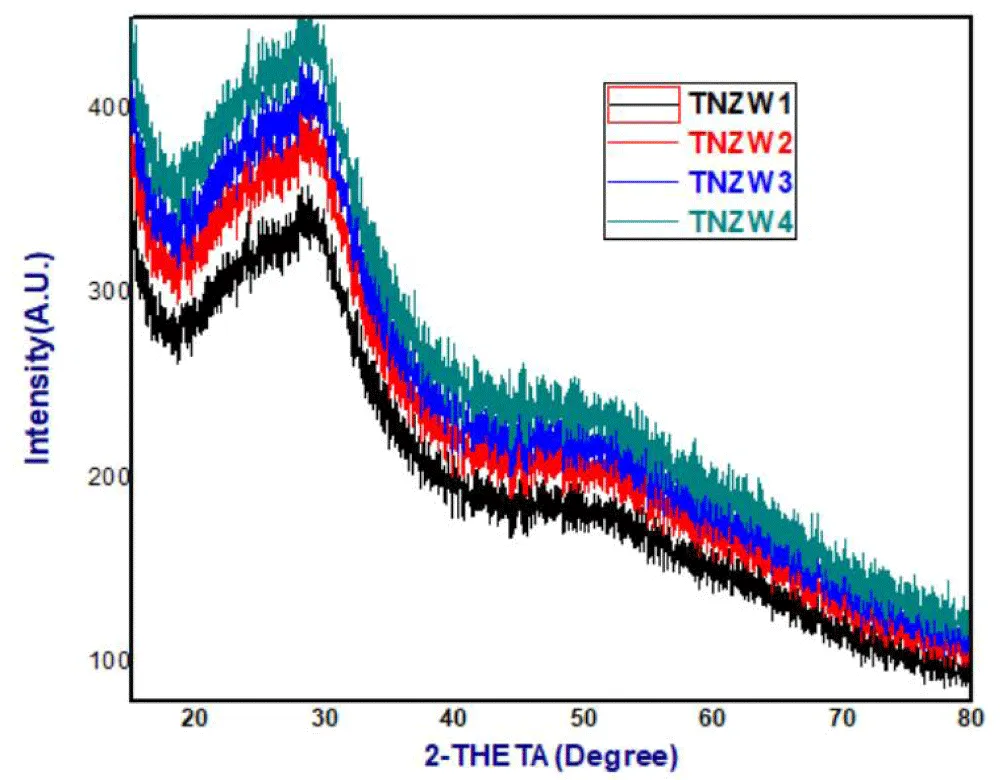
All the samples (TNZW1, TNZW2, TNZW3, and TNZW4) exhibit a broad diffuse hump in the region of approximately 20°–35°, without any sharp diffraction peaks. Such a broad halo pattern is a typical characteristic of amorphous materials, indicating the absence of long-range crystalline order in the prepared glass samples [11,12]. The similarity in the diffraction patterns for all compositions confirms that the addition of WO3 does not induce the formation of crystalline phases within the glass matrix. However, slight variations in the intensity and shape of the broad hump suggest minor structural modifications in the glass network with increasing WO3 concentration. These structural changes may be attributed to the incorporation of tungsten oxide units into the tellurite glass network, which can influence the short-range structural arrangement of the glass system [13]. Thus, the XRD results confirm that all the prepared TNZW samples possess an amorphous glassy structure, demonstrating that the melt-quenching technique used in this work successfully produced homogeneous tungsten TGs suitable for further structural and optical investigations [12,14].
Differential Scanning Calorimetry (DSC)
The Differential Scanning Calorimetry (DSC) curve of the (80–x)TeO2 – 10ZnO – 10Na2O – xWO3 glass system (x = 5, 10, 15, and 20 mol%) is presented in Figure 2. The thermal analysis was carried out using a TA Instruments Q10 differential scanning calorimeter in the temperature range of 45 °C to 500 °C at a constant heating rate of 10 °C min-1. The DSC technique commonly investigates the thermal behavior of glass materials, which include glass transition, crystallization, and thermal stability.
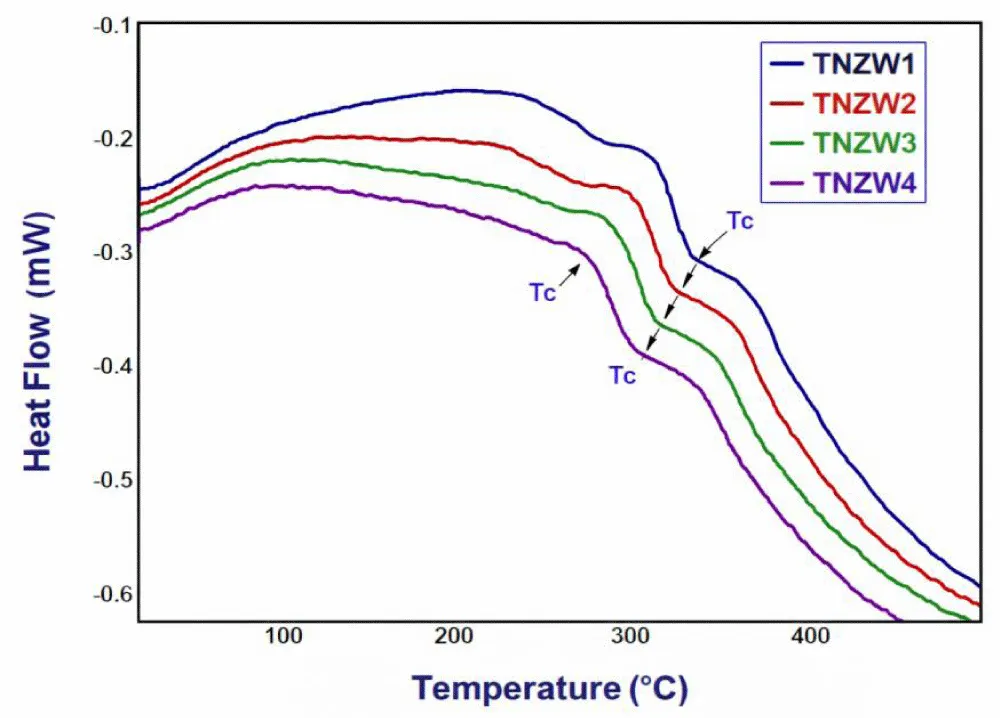
The DSC thermograms of the (80–x) TeO2 – 10ZnO – 10Na2O – xWO3 glass system (x = 5, 10, 15, and 20 mol%) exhibit consistent thermal features with distinct compositional dependence. In the low-temperature region, all samples display a gradual baseline shift, which can be attributed to structural relaxation and progressive softening of the glass network upon heating. In the intermediate temperature range, a noticeable change in slope is observed for all compositions, corresponding to the glass transition temperature (Tg). This transition signifies the transformation of the rigid glassy network into a supercooled liquid state, driven by increased mobility of structural units within the glass matrix [12,14]. At higher temperatures (~300°C–350°C), a well-defined exothermic peak is evident, corresponding to the crystallization temperature (Tc). This thermal event represents the onset of nucleation followed by crystal growth within the amorphous phase [15]. The sharp and distinct nature of the exothermic peak indicates that the material remains in a stable glassy state up to the crystallization stage, which is characteristic of oxide glass systems [14-16]. A systematic shift of Tc toward lower temperatures is observed with increasing WO3 content from TNZW1 to TNZW4, suggesting that the incorporation of WO3 facilitates earlier crystallization. This behavior may be associated with modifications in the glass network connectivity and the introduction of structural units that promote nucleation. Furthermore, the thermal stability of the glasses was evaluated using the parameter ΔT = Tc − Tg. A decreasing trend in ΔT with increasing WO3 concentration is observed, indicating a reduction in resistance to crystallization. Among the investigated compositions, TNZW1 exhibits the highest ΔT value, reflecting superior thermal stability, whereas TNZW4 shows comparatively lower stability due to the reduced separation between Tg and Tc. Overall, the results demonstrate that increasing WO3 content significantly influences the thermal behavior of the glass system by lowering both Tg and Tc and reducing thermal stability. This compositional dependence is crucial for optimizing processing conditions and tailoring the material for optical and related technological applications.
Raman spectrum
The Raman spectrum of tungsten tellurite glass TNZW1 with the composition 75TeO2–10ZnO–10Na2O–5WO3 (mol%) recorded in the spectral range of 200–1200 cm-1 is shown in Figure 3. The measurement was performed using a RI-D2R-S Direct Coupled Raman Spectrometer manufactured by Research India. Raman spectroscopy is widely used to investigate the vibrational behavior and short-range structural units present in oxide glass systems, particularly tellurite-based glasses.
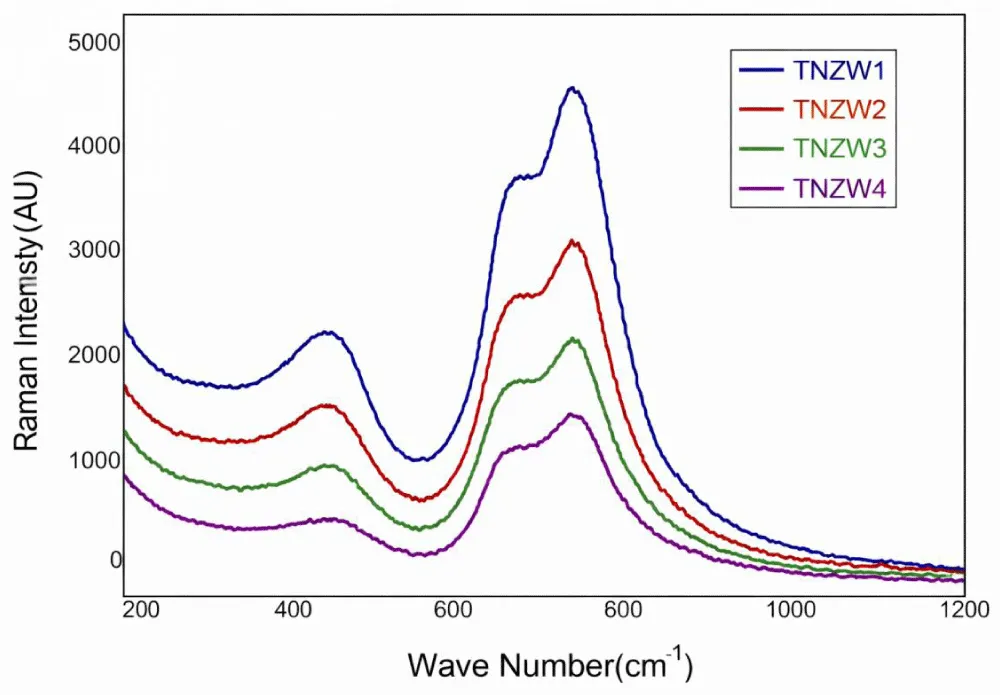
The Raman spectra of TNZW1, TNZW2, TNZW3, and TNZW4 glasses exhibit broad bands rather than sharp peaks, which is a typical characteristic of amorphous glassy materials due to the absence of long-range structural order in the glass network [17,18]. These broad features indicate the distribution of various structural units within the tellurite glass matrix. A weak band is observed in the lower wavenumber region (400–500 cm-1) for all compositions, which is attributed to the bending vibrations of Te–O–Te linkages in the glass. These vibrations correspond to Bridging Oxygen atoms (BO) connecting neighboring tellurium polyhedra and play a significant role in maintaining the connectivity of the glass structure [19]. Another band appears in the region of 650–700 cm-1, corresponding to the Te–O stretching vibrations in TeO2 Trigonal Bipyramidal (TBP) units. The presence of this band confirms that TeO2 units contribute to the structural framework of the tellurite glasses [18,20]. A strong and dominant band is observed in the range of 750–800 cm-1, which is typically associated with the stretching vibrations of Te–O bonds in TeO2 or TeO2+1 units. This band reflects the presence of Non-Bridging Oxygen (NBO) atoms and indicates structural modifications in the tellurite network, involving the conversion of TeO2 units into TeO2 units [18]. These bands are generally observed when modifier oxides such as Na2O and ZnO are incorporated into the tellurite glass matrix. With increasing WO3 content from TNZW1 to TNZW4, noticeable variations in the intensity and slight shifting of these bands are observed, indicating progressive modification of the glass network. The addition of WO3 influences the structure due to the formation of WO3 octahedral units, which interact with the tellurite network and lead to changes in the vibrational band positions and intensities. These structural modifications suggest alterations in the short-range order of the glass network, arising from the increased complexity of the system [21]. Overall, a systematic decrease in Raman band intensity, accompanied by a slight shift toward lower wavenumbers and an increase in the relative contribution of the ~750–800 cm-1 band, clearly indicates an increase in Non-Bridging Oxygen (NBO) concentration and progressive depolymerization of the tellurite network with increasing WO3 content.
Physical properties
The different parameters of HMO-doped TG samples were obtained, including density, Molar Mass (M), Molar Volume, Oxygen packing density, Zinc ion concentration, polaron radius, and inter-nuclear distance (Table 1) [22,23].
Our calculated physical parameters for the TNZW glass system gave us a clear picture of how WO3 affected the glass network and packing. The results showed that molar mass continuedto rise steadily through all samples from TNZW1 to TNZW4. This happened because of replacing TeO2 (a lighter ion) with a heavier ion, WO3. This resulted in a natural increase in molecular weight [24]. The density also increased through all samples by rising to 5.402 g/cm3 from 4.982 g/cm3, and confirmed that the structure was getting more compact owing to the addition of the heavy tungsten ions to the packing. This phenomenon has been reported for HMO glasses, revealing that the addition of a transition metal ion to a glass results in a tighter and more rigid glass structure [25, 26]. The results pointed to the molar volume (Vm) slightly falling through all samples as a result of adding WO3, and this is confirmed by the glass structure becoming more compact and rigid. This phenomenon has been reported earlier, demonstrating that a fall in molar volume accompanied by a rise in density results in a tighter glass structure, giving rise to stronger bonds and fewer free spaces within a glass matrix [24,26]. The oxygen packing density steadily rose through all samples. This phenomenon also confirmed that the glass structure was indeed becoming more connected and cross-linked, which should also make the glass more rigid and stable mechanically [27]. The tungsten ion concentration increased steadily across samples due to progressive WO3 addition, resulting in reduced Rp and Ri, as ions packed closer together within the glass matrix. This phenomenon is reported earlier for glasses where ion packing closer together results in a tighter and more rigid glass structure, which indicates greater localization of charge carriers within a glass matrix [26,27]. The field strength also rose through all samples by rising to 2.100 x 10¹⁷ nm-2 from 0.826 x 10¹⁷ nm-2. This phenomenon also confirmed that the glass structure was indeed becoming more compact and rigid because of the strong electrostatic attraction between cations and oxygen ions within a glass matrix.
Conclusion
The melt-quenching method was implemented for the preparation of tungsten-doped TGs with composition (80−x)TeO2–10Na2O–10ZnO–xWO3 (x = 5 to 20 mol%). X-ray diffraction patterns revealed broad halos for all synthesized samples, confirming their fully amorphous nature even after the incorporation of WO3 The glass transition and crystallization temperatures, determined using DSC, indicated good thermal stability of the prepared glasses. The Raman spectra revealed TeO2, TeO2, and WO3 as the key structural units present in the glass network. With increasing WO3 content, a gradual transformation from TeO2 to TeO2 units was observed, indicating the formation of additional non-bridging oxygens and consequent network rearrangement. The evaluated physical properties showed that parameters such as density increased with increasing WO3 content, while molar volume, polaron radius, and interionic distance decreased. These results suggest that the glass network becomes more compact, with improved packing density and stronger bonding. Based on these findings, it can be concluded that the incorporation of WO3 effectively tunes the structural and physical properties of the glasses, leading to enhanced density, thermal stability, and rigidity. These characteristics make the TNZW glasses promising candidates for photonic and optical applications. Furthermore, the observed increase in density and compactness suggests their potential suitability for radiation shielding applications; however, detailed shielding studies are required to substantiate this aspect.
References
- Jha A, Richards B, Jose G, Teddy-Fernandez T, Joshi P, Jiang X, et al. Lousteau, Rare-earth ion doped TeO2 and GeO2 glasses as laser materials. Progress Mat Sci. 2012;1426–1491. Available from: https://doi.org/10.1016/j.pmatsci.2012.04.003
- El-Mallawany R, TGs Handbook: Physical Properties and Data, 2nd ed. CRC Press. 2012. Available from: https://www.taylorfrancis.com/books/mono/10.1201/b11295/tellurite-glasses-handbook-raouf-el-mallawany
- Elliott SR. Physics of Amorphous Materials. 2nd ed. Longman Scientific. 1990. Available from: https://www.scirp.org/reference/referencespapers?referenceid=1505499
- Wang JS, Vogel EM. Journal of the American Ceramic Society. 1990;73(2):507–510.
- Nogami M, Abe Y. Properties of sol—gel-derived Al2O3SiO2 glasses using Eu3+ ion fluorescence spectra. Journal of Non-Crystalline Solids. 1996;197:73-78. Available from: https://doi.org/10.1016/0022-3093(95)00621-4
- Dimitrov V, Komatsu T Classification of Simple Oxides: A Polarizability Approach. Journal of Solid State Chemistry. 2002;163:100–112. Available from: https://www.sciencedirect.com/science/article/abs/pii/S0022459601993788
- Boolchand P, Georgiev DG, Goodman B. The Characterization and Study of Physical Parameters of Ge Modified Se-Sn-Pb Chalcogenide System. Journal of Optoelectronics and Advanced Materials, 2001;3:703–720. Available from:https://www.scirp.org/reference/referencespapers?referenceid=977454
- El-Mallawany R, Tellurite Glasses Handbook: Physical Properties and Data. CRC Press.2002;374271–4278. Available from: https://www.scirp.org/reference/referencespapers?referenceid=2901224
- Tauc J, Grigorovici R, Vancu A. Optical Properties and Electronic Structure of Amorphous Germanium. Physica Status Solidi. 1996;15:627–637. Available from: https://www.scirp.org/reference/referencespapers?referenceid=1264628
- Urbach F. The Long-Wavelength Edge of Photographic Sensitivity and of the Electronic Absorption of Solids. Physical Review1953;92:1324–1324. Available from: https://scirp.org/%28S%28i43dyn45teexjx455qlt3d2q%29%29/reference/referencespapers?referenceid=362277
- Doremus RH. Glass Science, 2nd ed. Wiley. 1994. Available from: https://www.scirp.org/reference/referencespapers?referenceid=172810
- Varshneya AK, Mauro JC. Fundamentals of Inorganic Glasses, 2nd ed. Elsevier. 2019. Available from: https://www.sciencedirect.com/book/monograph/9780128162255/fundamentals-of-inorganic-glasses
- Tatsumisago M, Halfpap BL, Green JL, Lindsay SM, Angell CA. Journal of Non-Crystalline Solids. 1994; 177:154–160.
- Shelby JE. Introduction to Glass Science and Technology, 2nd ed. Royal Society of Chemistry. 2005. Available from: https://belglas.com/wp-content/uploads/2021/01/shelbyj.e.introductiontoglassscienceandtechnology2nded.rsc20050854046399.pdf
- Doremus RH. Glass Science, 2nd ed. Wiley. 1994. Available from: https://www.scirp.org/reference/referencespapers?referenceid=172810
- Elliott SR. Physics of Amorphous Materials, 2nd ed. Longman Scientific. 1990. Available from: https://www.scirp.org/reference/referencespapers?referenceid=1505499
- Doremus RH. Glass Science, 2nd ed. Wiley. 1994. Available from: https://www.scirp.org/reference/referencespapers?referenceid=172810
- Mekki A, Khattak GD, Holland D, Chinkhota M, Wenger LE. Structure and magnatic properties of vanadium –sodium silicate glasses. Journal of Non-Crystalline Solids. 2003; 318:193–201. Available from: https://www.sciencedirect.com/science/article/abs/pii/S0022309302018835
- Heo J, Mackenzie JD, Uhlmann DR. Journal of Non-Crystalline Solids. 1989;111:29–35.
- Dimitrov V, Komatsu T. Journal of Non-Crystalline Solids. 1999; 249:160–179.
- Komatsu T, Matusita K, Minami K. Journal of Non-Crystalline Solids. 1991;135:105–113.
- Ansari GF, Patidar S, Pandey R, Kumar R. Materials Science Forum2023;1097:71–76.
- Kumari H, Ansari GF, Mahajan SK, Rezaul KS, Bairagi S. Materials Today: Proceedings. 2023.
- Varshneya AK. Fundamentals of Inorganic Glasses. Academic Press. 1994. Available from: https://www.scirp.org/reference/referencespapers?referenceid=1505990
- Bridge B, Patel ND. Structure–property relationships in TGs. Journal of Non-Crystalline Solids. 1987.
- Sayyed MI. Physical properties of heavy metal oxide glasses. Journal of Alloys and Compounds.
- El Batal H. Role of transition metal ions in glass structure. Materials Chemistry and Physics. 2008.
Advertisement



 Save to Mendeley